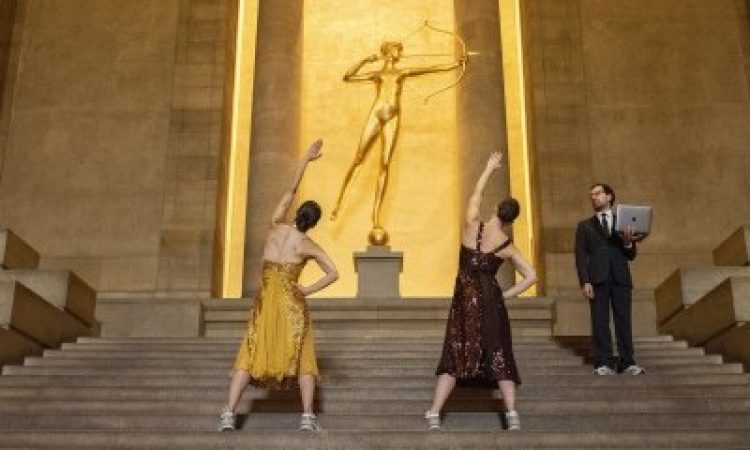
The only way I could review Monica Bill Barnes & Company’s Museum Workout was to be in it. There were no spectators, only participants. So I donned sneakers and exercise clothes and took part in this self-described workout, guided tour and performance at the Philadelphia Museum of Art. I must confess to being skeptical beforehand. Aerobics is robotics, in my view—and this event sounded like a contrivance to breathe new life into the museum-going experience.
Barnes’ mission, as her release states, is to “bring dance where it doesn’t belong,” and here her intent was to “change the way audience feels about being in a museum.” Cheer on the former; the latter though, from this experience, is up for lots of debate.
After being instructed by Barnes and her associate Anna Bass to “do exactly what we do,” about a dozen of us embarked on a 50 minute, 2 ½ mile speedy excursion with brief stops in front of almost 20 iconic, largely Western European master paintings. We followed simplified and repetitive aerobic routines (hands to hips, shoulders, outstretched and then release; pumping arms diagonally overhead). The music generated from a laptop was heavily 70s and disco with the Bee Gees (Stayin Alive, How Deep Is Your Love) and Sly & the Family Stone (Dance to the Music, Thank You (Falettinme Be Mice Elf Agin)) predominating.
There is irony in hearing the Lionel Richie-composed Easy (Like Sunday Morning) while doing soft pliés before the stern gaze and half veiled face of Titian’s Archbishop Filippo Archinto. But being a bit bored by the formulaic movement and mildly frustrated by the hit-and-run structure of the piece, I was in active search of more irony. I might have found it in the welcoming hand responding to our antics in Anne-Rosalie Bocquet Filleul’s Portrait of Benjamin Franklin, or the utter indifference to us of both Picasso’s Self-Portrait with Palette and Duchamp’s The Bride Stripped Bare by Her Bachelors, Even (The Large Glass).
The artwork had been selected by illustrator and writer Maira Kalman whose pre-taped narration offered inspirational observations (museum art as “guardian angels, giving us a sense of purpose”). Kalman, in my mind, also brought into question the whole Barnes exercise: “Be in the moment, just look at the art.” Here the looking was circumscribed, hurried and often following Barnes and Bass.
More fundamentally, Museum Workout lacked any individualized, kinetic responses to the art either from Barnes and Bass, or the audience. Improvisation was precluded, although I broke the rules and at times found refuge in improvising. Beyond offering abbreviated exposure to art, a choreographer especially might be exploring how audience movement can engage with visual art and enhance the looking and contemplating with a more total body and art experience.
Museum Workout, Monica Bill Barnes & Company, Co-presented by Philadelphia Museum of Art, Sept. 12-17.