In a quest to reach new audiences for performing arts in Philadelphia, Theatre Philadelphia and thINKingDANCE are joining forces and exploring how dance writing and discourse can provide new perspectives on theater. Beginning May 2018, tD writers have been lending their varied backgrounds, interests, and approaches to criticism to professional works of theater in Philadelphia. Let us know what you think in the comments!
It’s a thrill to witness a production that sweeps me in so thoroughly that the dim rise of house lights for intermission causes me mild shock. When the lights come up at the end of playwright Dominique Morisseau’s Mud Row, I am startled to find that the sun has gone down some time ago.
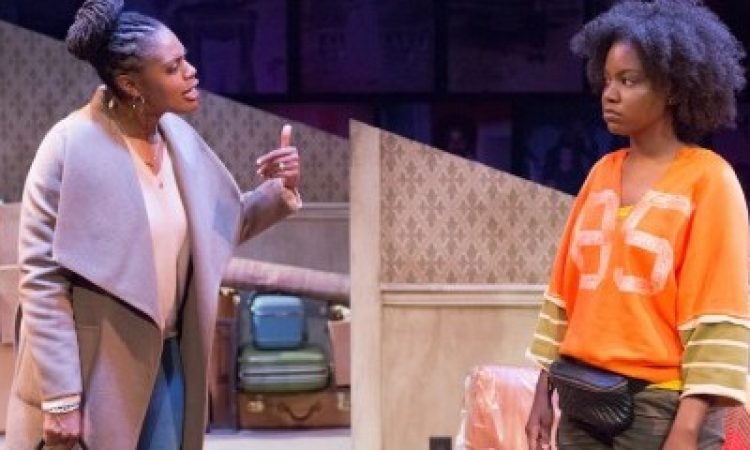
The play, directed by Steve H. Broadnax III and premiered at People’s Light, develops in the microcosm of a family’s home in the East End of West Chester, PA. One set of sisters (Tiffany Rachelle Stewart’s Elsie and Gillian Glasco’s Frances) grapples with class, race, and family history in the era of the civil rights movement. The other set (Nikkole Salter’s Regine and Renika William’s Toshi) deals with much of the same in contemporary times. Two generations on a maternal line, one in the era of the civil rights movement and the other today, wade through the waves of life within the house’s confines; the play flings us back and forth between time periods. The characters dance the tender tango between embracing their identities and belongings, abandoning them in wild denial, and using them to get further in society (and, perhaps, away from home). The interior of the row home’s first floor is thick with a generational energy that has seeped into the walls; a physical manifestation of the family’s “stick-in-the-mud” status.
I watch the story unfold with a certain level of mirth. My own mother recently inherited and moved into her parents’ old home (with all of its contents) at the nape of the Northern Neck of Virginia, where my grandmother’s family has lived for generations. Wandering through the halls, as boxes are moved and belongings sorted, I can feel stories and unresolved traumas billowing up with the dust.
Morisseau, a Tony Award nominee and MacArthur Genius Grant Fellow, writes with incredibly poetic clarity. In a heated argument with younger sister Toshi over the inheritance of their grandmother’s home, Regine insists, “My insides are gone; I’m empty; you’ve taken everything I have!” In a monologue directed to her infant daughter, the to-be mother of Regine and Toshi, Elsie muses, “Some women [like her sister, Frances] want to change the world; I am content to fit into whatever space becomes available to me.” Morisseau’s use of language evokes salient, rich imagery without forsaking a realistic conversational tone.
The beaus of the younger generation, Bjorn DuPaty’s Davin and Eric Robinson Jr.’s Tyreik, are in some ways diametrical opposites; Davin is calm and trusting, Eric has been too often betrayed by the world to react from a place of faith. On the other hand, they are both supportive partners, pushing Regine and Toshi towards their newer, better selves. The men in Elsie and Frances’ lives are tangential to the central relationships that we see unfold during the course of the play. Elsie becomes infatuated with an intellectual man in a loftier position in society. She falls while pregnant, he hits her and refuses to help, he has a change of heart and promises to marry her, and he abandons her at the altar. The only interaction we see between Frances and a man is in silhouette behind the backdrop; at a protest against segregated restaurants, he spits on her and beats her with a brick. Many times, Elsie affirms that Frances is all she has in the world. Davin and Tyreik represent the different paths Regine and Toshi have chosen for themselves that lead them away from each other.
The actors in the four female lead roles play the characters with delicate layers of steeliness, sass, and softness. In a climactic dialogue between Regine and Toshi, they scream and laugh and say just what the other needs to hear before hurling a stinging truth. Toshi then hesitantly asks her older sister if she’s seen the massive tree they used to play under in the backyard. The roots, she says, are growing into the foundation of the house and might crack it open: an apt manifestation of the family lineage that threatens to overwhelm the two sisters, as it did their foremothers.
To join the conversation, follow thINKingDANCE and Theatre Philadelphia online and on social media to read, share, and comment.
Mud Row, Dominique Morisseau, People’s Light, June 6 – August 4.